Healthy Eating Doesn't Have to Look Perfect
For a long time, I imagined healthy eating as something that looked incredibly organised. I pictured neatly packed meal prep containers, perfectly balanced plates, colourful vegetables at every meal, and someone who never seemed tempted by takeaway or dessert. It all looked so effortless that I assumed I simply wasn’t disciplined enough to do it.
The strange part was that I wasn’t comparing my eating habits to real people. I was comparing them to an idea.
The more I paid attention, the more I realised that the version of healthy eating I’d built in my head didn’t leave much room for ordinary life. There were no busy days, no family celebrations, no last-minute meals, no cravings, and no evenings where convenience simply made more sense. Looking back, I think I made healthy eating feel much more complicated than it ever needed to be.
The Picture I Had of Healthy Eating
I’m not entirely sure where that picture came from.
Maybe it was social media. Maybe it was years of seeing nutrition presented through carefully arranged photos and perfectly planned routines. Whatever the reason, I slowly started believing that healthy eating only counted if it looked impressive.
A homemade meal wasn’t enough if it wasn’t perfectly balanced. A week of reasonably good choices somehow felt less important because I’d also had dessert one evening. Instead of looking at my overall healthy eating habits, I found myself judging individual meals as though each one had to prove I was doing things properly.
The more I thought about it, the more unrealistic that expectation seemed. We don’t usually judge the rest of life that way, yet food somehow became the one area where perfection felt like the minimum standard.
Real Life Doesn't Look Like That
One thing I’ve noticed is that real life has a habit of interrupting perfect plans.
Some weeks there’s plenty of time to cook. Other weeks you’re eating whatever fits between work, errands, family commitments, or simply trying to make it through a busy day with enough energy left to think about dinner.
That doesn’t mean healthy eating disappears. It simply looks different.
Sometimes it’s choosing a homemade meal even if it isn’t perfectly balanced. Sometimes it’s adding fruit alongside breakfast instead of changing the entire meal. Sometimes it’s ordering takeaway because that’s realistically the best option that day and carrying on with your usual routine afterwards.
That last part took me a while to understand. I explored a similar idea in Why One Unhealthy Meal Won’t Ruin Your Progress, where I realised that our long-term progress is shaped far more by what we do consistently than by one meal that didn’t go according to plan.
A Balanced Diet Is Built Through Ordinary Days
The longer I’ve tried to improve my nutrition, the less interested I’ve become in impressive meals.
I’m much more interested in ordinary ones.
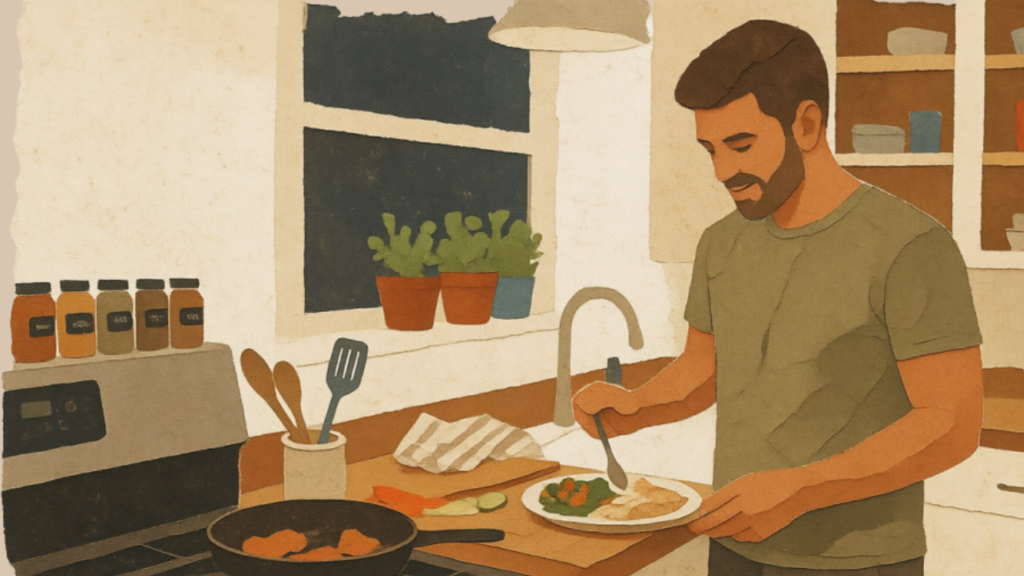
The meals that don’t get photographed—the ones you quickly put together after work, eat while chatting with family, or make because they’re simple enough to repeat next week.
I think that’s where a balanced diet is actually built.
Not through perfect days that happen occasionally, but through ordinary days that happen all the time.
Those meals rarely feel exciting, yet they’re often the reason healthy eating habits become sustainable. They don’t demand perfect circumstances or endless motivation. They quietly fit into everyday life, which means you’re much more likely to keep making similar choices over the months that follow.
Ironically, the less I expected my meals to look perfect, the easier it became to eat well more often.
What Changed the Way I Think About Healthy Eating
I don’t think my eating habits changed because I suddenly found more discipline.
They changed because my expectations became more realistic.
Instead of asking whether my meals looked like the version of healthy eating I’d imagined, I started asking whether they were roughly the kind of meals I wanted to eat most of the time.
That question feels much easier to answer.
It also leaves room for life to happen without making every imperfect choice feel like a failure.
I wrote something similar in Why I Stopped Calling Foods “Good” and “Bad”, where I realised that removing unnecessary pressure often made healthier choices feel more natural rather than more difficult. Looking back, I think these ideas are connected. The less we expect healthy eating to look perfect, the less likely we are to abandon it the moment life becomes messy.
Progress Over Perfection
The picture I had of healthy eating was never completely wrong.
A balanced diet does include nutritious foods, and healthy eating habits still matter.
The part I misunderstood was what those habits actually look like over time.
They aren’t built through perfectly planned weeks where every meal goes exactly as expected. They’re built through ordinary choices repeated often enough that they become part of everyday life, even when that life is busy, unpredictable, or occasionally inconvenient.
I’ve started thinking that healthy eating becomes much more sustainable when we stop trying to make it look impressive. Most of the habits that quietly improve our health don’t attract much attention at all. They’re simply realistic enough to survive the kind of life most of us actually live.
Because progress was never about building a perfect plate every single day.
It was about building an approach to healthy eating that works with real life instead of waiting for perfect circumstances.